





Intelligent Evolution: When Waiting Chairs "Learn" to Interact with People
From Static Facilities to Dynamic Data Interfaces
Traditional waiting chairs are purely "terminal" facilities; their status (whether occupied, whether intact) requires manual inspection or user feedback to be known. The core of intelligence lies in transforming them into "initial ends for data collection and interaction." By embedding pressure sensors, Bluetooth beacons, or IoT modules, a waiting chair can real-time sense its usage status, occupancy duration, and even, through non-privacy-invasive methods (such as infrared sensing), determine the basic state of the user (e.g., prolonged stillness might indicate discomfort or a need for assistance). This data is aggregated to a cloud management platform, forming a "heatmap" of space utilization.
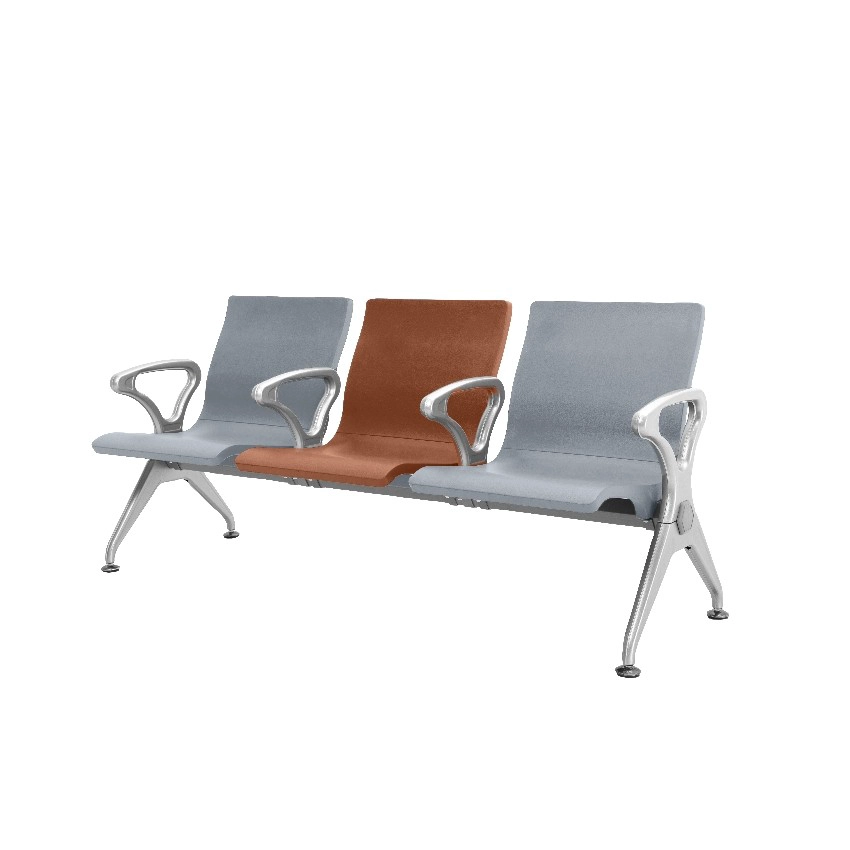
For facility managers, this is incredibly valuable. At airports, the system can dynamically guide passengers to vacant areas, balancing the flow of people at each boarding gate; in hospitals, data on seat occupancy outside consulting rooms can be linked to the queuing system, providing a reference for triage and allocation of medical resources; in libraries, prolonged seat occupancy can be mitigated through gentle reminders (such as flashing armrest lights). Smart waiting chairs are no longer isolated entities, but have become key infrastructure for optimizing operational efficiency and improving service response speed.
Extended Interaction Functions: Unlimited Service Possibilities in Limited Space
Another transformation brought about by intelligence is the extension of service functions. Limited physical space is thus endowed with unlimited potential for service expansion. Beyond the aforementioned wireless charging, some high-end seating scenarios are beginning to integrate the following features:
Information Interaction Screen: A small touchscreen integrated into the armrest allows users to check flight and train schedules, service procedures, city maps, and even provides simple entertainment information, transforming waiting time into productive information acquisition time.
Environmental Control Unit: The seats can feature localized heating or ventilation functions, enabling personalized microclimate control in large spaces, especially catering to the needs of the elderly and those with health vulnerabilities.
One-Click Calling and Emergency Response: In special locations such as nursing homes and hospitals, integrated physical or touch-sensitive call buttons connect directly to service centers, ensuring safety.
The combination of these functions transforms the waiting chair from a simple "seat" into a comprehensive "service terminal." Its design logic shifts from "providing the same seat for everyone" to "providing flexible services tailored to different needs for the same seat."
Privacy, Cost, and the Future: A Sober Reflection on Smart Technology
However, the path to widespread adoption of smart waiting chairs is not without challenges. The primary challenge is privacy and security. Any data collection must be based on strict laws, regulations, and ethical frameworks, ensuring anonymization and de-identification, and requiring clear notification and authorization to prevent data misuse. Secondly, cost and durability are concerns. The inclusion of electronic components significantly increases the cost per chair and the complexity of maintenance. In public, high-frequency use, and complex environments, their reliability and lifespan face severe tests. Furthermore, the digital divide must be addressed, ensuring that basic services are not compromised by the introduction of smart technology.
Looking ahead, with the decreasing cost of the Internet of Things, the maturity of low-power wide-area network technology, and the development of artificial intelligence edge computing, smart waiting chairs will become more "unobtrusive" and efficient. They may no longer require conspicuous screens but instead interact with the environment in a seamless manner. For example, pressure sensor arrays could detect posture and remind those sitting for extended periods to move; sound sensors (without recording) could identify ambient noise levels and automatically adjust background music volume.
From "being chosen" to "being responsive," the intelligent evolution of waiting chairs is essentially a microcosm of the transformation of public services from extensive management to refined governance, and from standardized supply to humanized care. This chair is becoming more "understanding" and considerate.