





The Pop-Up Classroom: How a Shipping Container Transforms into a Fully Furnished School with Integrated School Desk and Chair Systems in Under an Hour
When an earthquake reduced hundreds of schools to rubble in southern Turkey, the international community faced a brutal question: how do you deliver not just a building, but a complete, ready-to-use learning environment, before a generation loses a year of schooling? The answer arrived in a shipping container — one that unfolds into a weatherproof classroom with a school desk and chair for every student already bolted in place, waiting only for a teacher and a whiteboard marker.
The logistics of post-disaster and rural education infrastructure have always been tripped up by a final, infuriating mile. You can drop a tent, but then you must wait weeks for separate shipments of furniture — chairs that don't match the tables, desks that wobble on dirt floors, and plastic stools that shatter within months. The "EduBox" system, developed by a consortium of humanitarian engineers, architects, and furniture manufacturers, collapses this supply chain into a single, self-contained unit. Each standard 40-foot shipping container is fabricated into a flat-pack classroom shell with integrated insulation, solar panels, and a rainwater collection system. But the real innovation is in the interior: mounted to the container walls are rows of folded, cantilevered school desk and chair units. When the container is craned into place and the walls are deployed, a team of four volunteers can lower each desk and chair set from its locked stowed position, clicking it into a secure, floor-anchored configuration. Within forty-five minutes, a bare metal box becomes a fully furnished classroom for thirty-six students, every child seated at a sturdy, ergonomic school desk and chair.
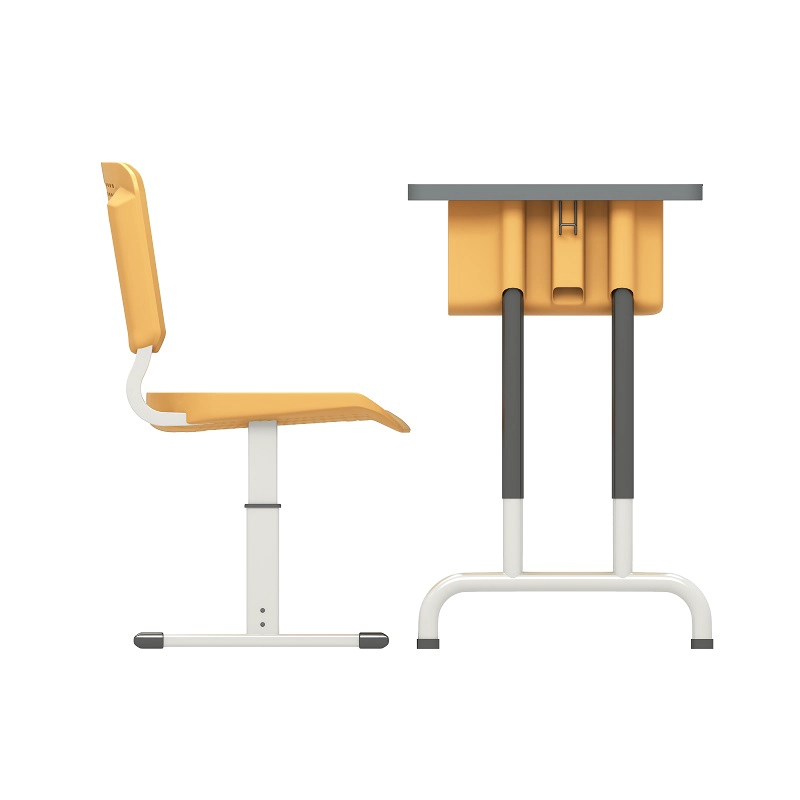
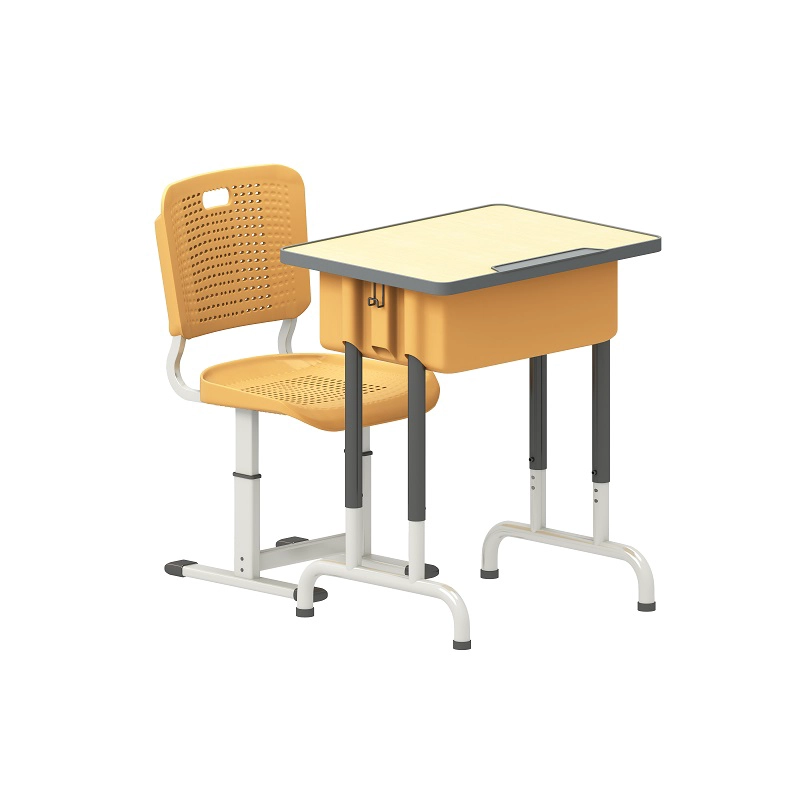
The engineering of this wall-mounted school desk and chair is a masterclass in flat-pack kinetics. The desk is a slim, aluminum-framed panel surfaced with a white, high-pressure laminate writing surface. The chair is a contoured polypropylene shell with a steel sled base. In the stowed position, the chair nests inside the desk frame, the whole assembly projecting less than 20 centimeters from the wall. A gas strut and locking bar mechanism allows the unit to be lowered smoothly without pinched fingers, and the floor anchors are adjustable for uneven terrain. Because the school desk and chair units are permanently attached to the container wall, they cannot be stolen, lost, or damaged during transport. Each unit also integrates a slim, lockable storage compartment under the seat for a child's personal supplies, and a built-in, crank-powered LED reading light that can run for ten hours on a one-minute winding session. The entire classroom is an independent, off-grid learning ecology.
The impact on educational continuity in crisis zones has been profound. In a pilot deployment in the Hatay region, seven EduBox containers were operational within a week of delivery, serving over 1,200 children in double-shift sessions. The provision of a dedicated, personal school desk and chair for each child, even in the midst of a shattered landscape, had a remarkable psychosocial effect. Teachers reported that children who had been withdrawn and traumatized by the destruction of their homes and neighborhoods showed visible relief upon sitting at their assigned seat — the simple act of having a defined, safe, personal workspace restored a fragment of normalcy. The desk surface was labelled with the child's name by a volunteer, a small ritual of belonging. The school desk and chair, in this context, was not merely furniture; it was a scaffold for psychological recovery.
The EduBox concept is now being adapted for non-emergency settings, particularly in remote mining and indigenous communities in Canada and Australia where permanent school buildings are not economically feasible. The containerized classroom, with its integrated school desk and chair fleet, can be relocated as a community migrates seasonally, or consolidated with other containers to form a modular school campus. The cost per unit, including the container, solar system, and all thirty-six desks and chairs, runs around $28,000, making it cheaper and faster than traditional brick-and-mortar construction in remote locations. As climate change intensifies the frequency of extreme weather events and displacement, the ability to deliver a turnkey school in a box — desks, chairs, blackboard, and all — will become an essential humanitarian capability. The EduBox demonstrates that a school desk and chair is not just an object that sits in a building; it can be the seed around which a building is wrapped, an irreducible unit of educational space that can be deployed anywhere, to anyone, within hours.